Mindfulness · 4 min
Why the Himalaya feels different
Altitude does something to attention. Above three thousand metres, the mind stops racing ahead of the body and simply keeps pace with it.
Different ways to walk Manaslu.
Understanding the Manaslu region.
Who Drokpo is.
Altitude does something to attention. Above three thousand metres, the mind stops racing ahead of the body and simply keeps pace with it.
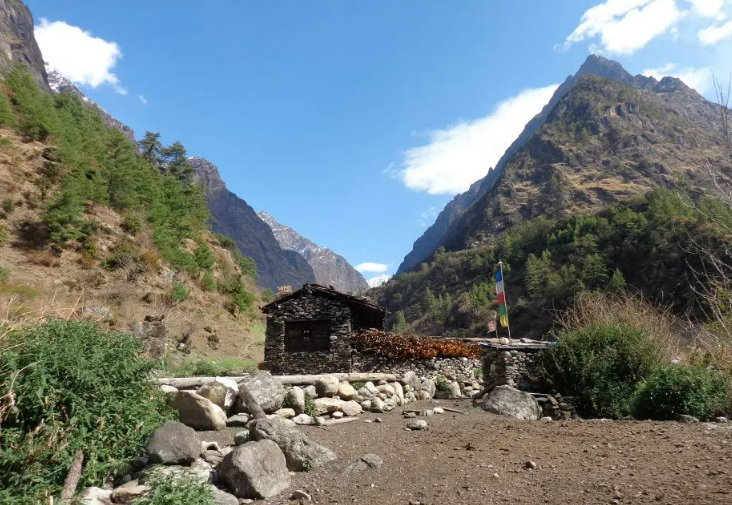
People come off the Manaslu Circuit saying a version of the same thing, and they say it with a slight embarrassment, as though describing a dream. Something happened up there. They are usually not able to say what.
It is worth taking the claim seriously without reaching for anything mystical, because most of what happens is explicable, and the explanation is more interesting than the mystery.
At sea level the body is a background process. You are not aware of breathing. You are aware of the argument you are rehearsing, the email you have not answered, the thing you should have said last Tuesday.
Above three thousand metres that arrangement inverts. Breathing stops being automatic and becomes a task with your full attention on it. Walking uphill requires a decision about pace. The body moves from background to foreground and, because attention is finite, something has to give ground. What gives ground is the interior commentary.
This is not a spiritual achievement. It is a resource constraint. But the effect is indistinguishable from the thing that meditators spend years trying to arrange deliberately: the mind stops running ahead of the body and starts keeping pace with it.
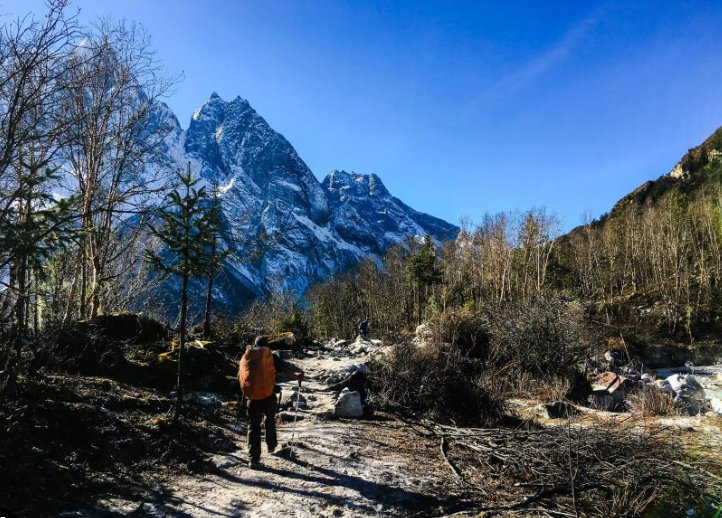
Above Lho. The pace is set by the air rather than by the schedule.
A teahouse day on this trail contains perhaps four decisions. When to get up. What to eat. When to leave. Whether to stop at the next village or the one after. That is the entire decision load of a waking day.
Most people have not experienced that since childhood, and the first reaction is often mild panic, followed a few days later by something that feels like relief so large it is hard to name. There is a considerable body of work on decision fatigue and how it depletes people. A fortnight on the Budhi Gandaki is an accidental clinical trial in removing it.
The other thing the day removes is the phone. Signal is patchy from Jagat and effectively gone above Namrung. Nobody in the history of this trail has ever chosen to give up their phone; the valley simply takes it, which turns out to be far more effective than choosing.
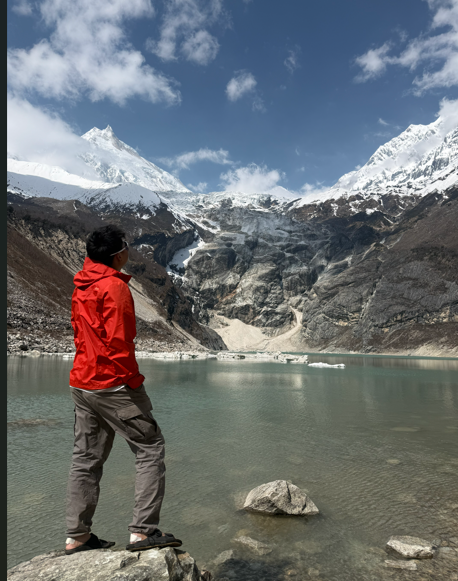
Manaslu is 8,163 metres, the eighth-highest mountain on earth, and unlike most peaks of that size it does not stand behind a screen of foothills. It rises almost directly above Samagaun. You sleep at 3,530 metres with four and a half vertical kilometres of mountain in the window.
Psychologists have a reasonably well-evidenced account of what large-scale natural surroundings do to people. The experience of awe reliably reduces the sense of self-importance and increases the sense of connection to others. It also, measurably, makes people feel that they have more time. That last finding is strange enough to be worth sitting with, because it maps exactly onto what trekkers report: the days feel long, in the good sense, in a way ordinary weeks do not.
The days feel long in the way childhood summers were long. Not slow. Just full of themselves.
The last part is not physiological. Nubri and Tsum have been Buddhist for a very long time, and the landscape is arranged accordingly. You walk past mani walls carved by hand over generations, keeping them on your right. You pass chortens at every village boundary. The gompas at Mu and Rachen have been running since the early twentieth century, and Tsum has held a formal vow against killing since 1920.
None of that requires belief from a visitor. But walking for two weeks through a landscape that has been shaped, stone by stone, by people practising attention as a discipline is not the same as walking through wilderness. The place has a position on how to be in it, and the position is legible even if you do not share it.
Tsum has kept a formal vow against killing animals since 1920.
Less than people hope, and more than they expect. The clarity of the trail does not survive contact with an inbox, and anyone who tells you otherwise is selling something.
What does survive is a reference point. You have direct evidence that your mind is capable of running quieter than it usually does, and that it took nothing more exotic than thin air, few decisions and a long walk to get there. Knowing a thing is possible is a smaller prize than keeping it, but it is not nothing. Most people who go back to the mountains are going back for the reference point.
Every Drokpo journey builds in a short morning practice for anyone who wants one, and nothing at all for anyone who does not. Both are normal, and roughly half of any group does each.
Tell us your dates and pace. A journey designer replies within two days.