
Reflection · 3 min
The meaning of silence in the mountains
There is no such thing as silence at Birendra Lake. There is only the absence of us, which turns out to be the thing people were actually looking for.
Different ways to walk Manaslu.
Understanding the Manaslu region.
Who Drokpo is.
There is no such thing as silence at Birendra Lake. There is only the absence of us, which turns out to be the thing people were actually looking for.
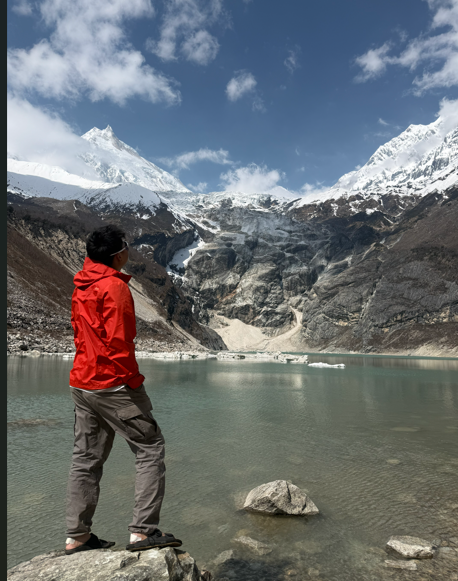
Birendra Lake sits at about 3,450 metres in the moraine below the Manaslu glacier, an hour above Samagaun. It is the standard walk on the acclimatisation day and it is where most groups first go quiet.
The word people use afterwards is silence, and it is the wrong word, which is worth noticing because the right word is more interesting.
The glacier makes noise constantly. Meltwater under the ice, rock shifting, and every so often the long dull crack of something falling several kilometres above you, which arrives late and from no particular direction. There is wind on the moraine. There are choughs.
What is missing is not sound. What is missing is human sound, and specifically the enormous low-frequency hum that every inhabited place produces and that nobody hears until it stops. No engine, no compressor, no distant road, no electrical hum. Most people have never in their lives been anywhere without it.
Birendra Lake, an hour above Samagaun, below the glacier.
Groups arrive at the lake talking and stop talking within a minute or two, and there is then a noticeable stretch where people fidget. Somebody takes photographs they do not need. Somebody starts a conversation and abandons it halfway through.
It passes. What follows, usually about a quarter of an hour in, is the thing people came for without knowing they were coming for it, and it is not peace exactly. It is closer to being small in a way that is a relief rather than a threat.
Nothing at the lake is aware of you. After a while that stops being lonely and starts being restful.
Partly geography. There is no road above Machha Khola, no airstrip in the region, and the restricted-area rules keep the numbers low. The absence of engine noise in Nubri is a policy outcome as much as a natural one.
Partly culture. Tsum has held a formal vow against killing animals since 1920, which is why the wildlife there is unafraid, and the whole landscape is arranged around practices that treat attention as a discipline. Mani walls, chortens at every village boundary, gompas that have been running morning and evening puja for a hundred years. The place is not neutral about quiet.
On some of our journeys the first hour or two of walking each day is done without conversation. It is the part of the itinerary people are most sceptical about beforehand and most attached to afterwards.
The reason is simple enough. Trail conversation is pleasant and it is also constant, and it draws on exactly the attention that would otherwise be available for the valley. An hour of not talking is not a discipline. It is just leaving the attention unspent so there is some left for where you are.
Nobody enforces it and nobody keeps score. The group defaults to quiet until the first tea stop, and then it stops. That is all it is.
What people report, almost without exception, is that they heard the river properly for the first time on the morning they stopped talking over it.
Tell us your dates and pace. A journey designer replies within two days.