Reflection · 3 min
What trekking teaches us about slowing down
Nobody arrives on this trail wanting to go slower. The valley makes the argument for you, and it makes it with physics.
Different ways to walk Manaslu.
Understanding the Manaslu region.
Who Drokpo is.
Nobody arrives on this trail wanting to go slower. The valley makes the argument for you, and it makes it with physics.
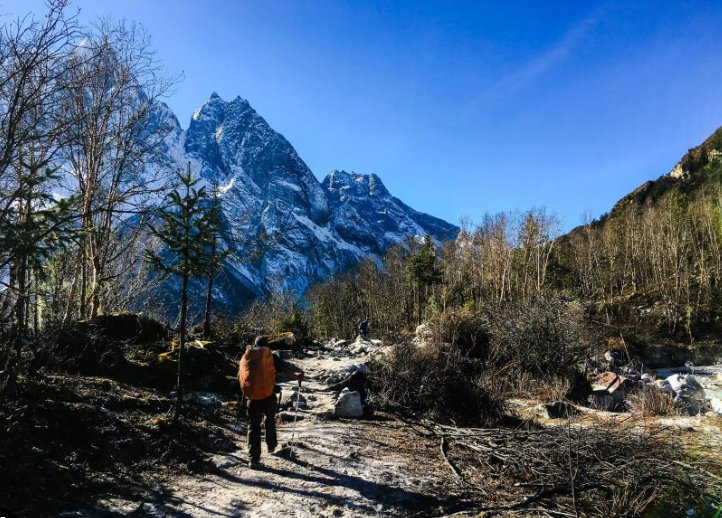
There is a particular kind of trekker who arrives in Kathmandu having read the itinerary and quietly decided it is too easy. They are fit, they run, they have looked at the daily distances and concluded that fourteen days is padding.
The Budhi Gandaki settles this argument within four days, and it settles it the same way every time.
Fitness determines how tired you get. It has very little to do with how well you acclimatise, and there is no training programme that changes that. Some of the strongest walkers on any group get the worst headaches, and the reason is often that being strong let them go too fast.
The standard guidance above 3,000 metres is to gain no more than about 500 metres of sleeping altitude a day and take a rest day roughly every 1,000. Those numbers are not a comfort preference. They are the rate at which human physiology adapts, and it is not adjustable by effort. On this trail, that is the whole reason the acclimatisation day at Samagaun exists and the reason we do not sell an itinerary without it.
You cannot try harder at acclimatising. It is the one part of the trek that responds only to patience.
The Samagaun rest day. Nothing to walk towards, which is the point of it.
Samagaun sits at 3,530 metres and every sensible itinerary stops there for a day. Groups walk up to Birendra Lake, or to Pungyen Gompa, or as far as base camp at around 4,800 metres, and then come back down to sleep at the same place they slept the night before.
Making no forward progress at all is uncomfortable for a lot of people in a way that walking twenty kilometres is not. It is the first day with no destination in it. A striking number of trekkers describe the Samagaun rest day afterwards as the day the trip actually started.
Beyond the physiology there is the simple fact that you are not in charge of the schedule. The mule train has right of way and you stand aside for it. The bridge below Deng is out or it is not. The lodge at Samdo has space or it does not. Weather closes the Larkya La or opens it, and no amount of planning moves that.
Modern life is arranged to hide this. Almost everything is available on demand, which quietly teaches that pace is a matter of will. Two weeks in a valley where it plainly is not is a correction people find unexpectedly restful once they stop fighting it. The fighting usually stops around day five.
There is a visible change in most groups somewhere above Namrung. People stop asking how far it is to the next village. They start stopping at tea houses they had not planned to stop at. Lunch takes an hour instead of twenty-five minutes. Somebody sits down on a wall for no reason at all.
None of that is instructed. It is what happens when a schedule stops being something to beat.
The villages keep their own pace. It is considerably older than the itinerary.
It would be dishonest to claim that two weeks in Nubri makes anyone permanently unhurried. It does not. Within a fortnight of landing, most people are back to checking a phone at traffic lights.
What lasts is narrower and more useful. You have spent fourteen days with direct evidence that the rush is optional, that a day with four decisions in it is a good day, and that going slower got you over a 5,106 metre pass in better shape than going fast would have. That is not a philosophy. It is just a thing you now know from the inside, and it is quite hard to fully unlearn.
Tell us your dates and pace. A journey designer replies within two days.