Preparation · 6 min
How to prepare for your first Himalayan trek
Training, kit, permits, insurance and money, for the Manaslu Circuit specifically. Everything on this page assumes you have not done this before.
Different ways to walk Manaslu.
Understanding the Manaslu region.
Who Drokpo is.
Training, kit, permits, insurance and money, for the Manaslu Circuit specifically. Everything on this page assumes you have not done this before.
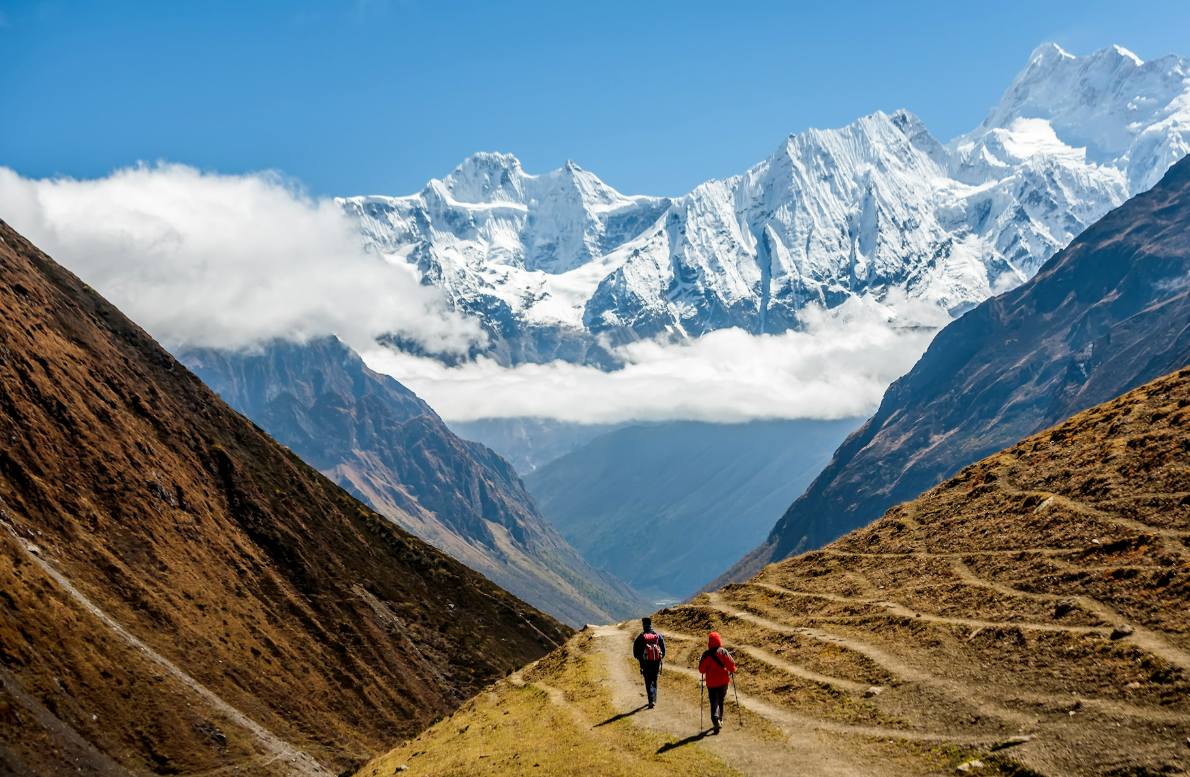
This is written for the Manaslu Circuit, which is a fourteen-day trek from around 900 metres to a pass at 5,106 metres, in a restricted area, with teahouse accommodation throughout. Most of it applies to any Nepali trek of similar length.
The single most useful thing you can do is walk downhill with a loaded pack. Ascent is limited by your lungs and your patience. Descent is limited by your knees and quadriceps, and it is descent that ends most people's comfortable trek. The drop from the Larkya La to Bimthang loses well over 1,500 metres, much of it steep, on tired legs, on day ten.
Start twelve weeks out if you can. Eight is workable, four is thin.
Build to one long walk a week of five to seven hours on hills, with the pack you will carry.
Deliberately seek out descent. Stairs and steep paths, not just uphill.
Add two shorter sessions a week: anything that raises your heart rate for forty minutes.
Do some single-leg strength work. Step-ups and lunges protect the knees more than cycling does.
Walk in the exact boots and socks you will bring. Every blister on the trail was preventable at home.
Altitude is the one thing training does not address. Fitness affects how tired you feel, not how well you acclimatise, and there is no way to prepare for thin air at sea level. Sleeping in an altitude tent is not worth the money for a trek at this height. The itinerary is what protects you, which is why the profile matters more than your training block.
The lower gorge has more ascent and descent in it than the elevation profile suggests.
Manaslu is a restricted area, so the paperwork is heavier than for Annapurna or Everest. Three permits are needed and an agency arranges all of them.
Restricted Area Permit | USD 100 per person for the first 7 days in September to November, then USD 15 per day. USD 75 for 7 days from December to August, then USD 10 per day. |
|---|---|
Manaslu Conservation Area Permit | USD 30 per person, flat. |
Annapurna Conservation Area Permit | Covers the final stage from Dharapani out to Besisahar. |
Two rules people ask about constantly. First, a licensed guide from a registered agency is mandatory throughout the restricted area, with no exceptions and no way around it. Second, the old requirement that a restricted-area permit be issued to a minimum of two trekkers was removed by the Department of Immigration on 22 March 2026, so a solo foreigner can now hold the permit alone. A great deal of published advice still says otherwise.
Permit fees are as of September 2026 and are revised from time to time. Check before budgeting.
You need a policy that explicitly covers high-altitude trekking in Nepal and includes helicopter evacuation and repatriation. Check the altitude ceiling on your own policy against the profile of the trek you are booking, and ask us if you are unsure.
Read the altitude clause specifically. A large number of standard travel policies cap cover at 4,000 metres, which on this route would leave you uninsured from roughly Samdo onwards, meaning for the pass and everything around it. Some exclude Nepal trekking entirely. Some cover the medical treatment but not the helicopter, which is the expensive part.
Bring the certificate with you. We check policies before departure, and finding a gap in Kathmandu is inconvenient. Finding one at Dharamsala is a great deal worse.
Teahouse trekking means no tent, no stove and no cooking gear. What you need is warmth for a wide temperature range, a small number of things that must not fail, and very little else. In October the middle valley sits around 15 to 16 °C by day and drops to about minus one at night above 4,000 metres, colder again at Dharamsala.
Boots. Broken in, ankle support, waterproof. The one item where the wrong choice ruins the trip.
Sleeping bag rated to about minus 10 °C for autumn, minus 15 °C for winter or early spring. Lodge blankets are not enough at Dharamsala.
A down jacket. Bulky and worth it, because the evenings above Samagaun are cold and lodges are unheated except for the dining room.
Waterproof shell, jacket and trousers, that actually works.
Two or three litres of water capacity, plus a filter or purification. There is no bottled water above Jagat, by our policy and increasingly by local rule.
A power bank, ideally 20,000 mAh. Charging exists in lodges but costs money and is unreliable above Samagaun.
Sun protection at strength. High-factor cream, lip balm with SPF, and category 4 sunglasses for snow.
Earplugs. Teahouse walls are plywood.
Blister kit, and the knowledge of how to use it before a hot spot becomes a blister.
Cash in small Nepali notes. See below.
A book. The evenings are long and the signal is gone.
Jeans, a second pair of boots, more than three changes of trail clothing, a heavy camera you will not use after day four, and anything you brought because it looked right. The porter load is capped for good reasons, and it is shared.
Your guide will check kit in Kathmandu. Take the suggestions seriously.
There are no ATMs on the trail. The last reliable cash is in Kathmandu, so draw what you need before you leave and bring it in small denominations, because a lodge in Samdo cannot change a 1,000 rupee note for a cup of tea.
Budget cash for hot showers, charging, wifi where it exists, snacks, drinks that are not tea, and tips. Prices rise steadily with altitude for the obvious reason that everything above Machha Khola arrived on a back or a mule.
See a travel clinic six to eight weeks before departure for vaccinations and to discuss acetazolamide, which does genuinely reduce the incidence of altitude sickness.
Bring a personal first aid kit including blister treatment, painkillers, rehydration salts and anything for stomach upsets.
Dental work should be done before you go. There is no dentist above Arughat.
Tell your guide about any condition or medication on day one, not on day nine.
Confirm your passport has at least six months of validity and get your Nepal visa arranged.
Send your agency a scan of the passport page so permits can be started.
Pack, weigh the bag, then remove two kilograms of things you will not miss.
Break in the boots properly if you have not already. This is the last chance.
Arrive in Kathmandu at least one full day before departure. That day absorbs a delayed flight and is when kit gets checked.
The itinerary is the safety equipment. If someone offers you this trek in ten days at a good price, what they are removing is the acclimatisation day.
Everything else can be fixed on the trail. Bad boots, thin insurance and a compressed itinerary cannot.
Tell us your dates and pace. A journey designer replies within two days.